Hi, business owners!
You see AI marketing tools everywhere. But which ones actually move the needle for your business? Most lists are fluff. You need real tools that solve real problems. This guide skips the hype and shows you exactly which platforms deliver ROI.
We test. You win.
Let's cut through the noise and find the best AI marketing tools that won't waste your time or budget.
What Are AI Marketing Tools?
AI marketing tools are software that uses machine learning to automate decisions, create content, and analyze data for you. Instead of guessing what your audience wants, these tools spot patterns and act on them. You can use them to write blog posts, manage ad spend, or personalize emails at scale. Think of them as a marketing assistant who never sleeps. They handle the repetitive stuff so you can focus on strategy. You will find tools for everything from SEO to social media management. The good ones learn from your data and get smarter over time. That's the power you want on your team.
How to Pick the Best AI Marketing Tools for Your Business
You don't need every shiny tool. You need the right ones. Here's how you find them.
- Match the tool to your specific problem. Don't buy a Swiss Army knife when you need a hammer. If your problem is writing product descriptions, get a specialized writer. If it's analyzing customer data, get an analytics platform. General tools often do many things poorly.
- Check integration with your stack. Your new AI tool must talk to your CRM, email software, and analytics. If it doesn't, you will spend hours moving data around. That defeats the purpose. Look for native integrations or solid API support before you pay.
- Test before you commit. Most of the best AI tools for marketing offer free trials. Use them. Run your actual campaigns through the tool. See if it saves you time. Measure the results. A tool that looks perfect on paper might fail with your specific data.
Types of AI Marketing Tools
AI marketing tools fall into several key categories. Here's what you will find on the market.
- Content generation tools: These write your blog posts, social media captions, and ad copy. You give them a topic, and they produce drafts you can edit. They save hours of staring at a blank screen.
- SEO optimization platforms: These analyze search results and tell you exactly which keywords to use. They score your content and show you how to outrank competitors. You get a clear roadmap, not vague advice.
- Social media management tools: These schedule posts, suggest optimal posting times, and generate engagement reports. Some even write platform-specific captions for you. You can manage multiple accounts from one dashboard.
- Analytics and data platforms: These connect your marketing data from every channel. They spot trends you would miss and predict customer behavior. You stop guessing what works and start knowing.
- Ad optimization software: These test hundreds of ad variations automatically. They shift budget to winning creatives in real time. You get better ROI without babysitting your campaigns.
- Personalization engines: These tailor website content, emails, and product recommendations to each user. They use browsing history and purchase data to serve the right message at the right time.
- Video creation tools: These turn text prompts into professional videos with AI avatars. You don't need a camera crew or editing skills. Just type your script and get a finished video.
- Influencer marketing platforms: These find relevant creators, verify their audiences, and track campaign ROI. They cut the manual work of searching and vetting influencers.
Why Use AI Marketing Tools Now?
The marketing game changed. Here's why you need AI tools today, not tomorrow.
- Your competitors are already using them. Small teams now outperform larger ones because they automate smartly. You lose ground every day you wait. The gap widens fast.
- Customers expect personalization now. Generic blasts don't work anymore. People ignore messages that feel mass-produced. AI helps you speak to each person like you know them.
- Data volume is overwhelming. You have more customer data than any human can process. AI finds the signal in the noise. It spots buying signals you would miss completely.
- Content demand keeps rising. Your audience expects daily posts, weekly emails, and regular blogs. You cannot keep up manually without burning out. AI writes the first draft so you can focus on refining.
- Ad costs are climbing. Every click costs more. You need precision targeting and constant optimization. AI manages your bids and placements better than any human could.
- AI tools are more affordable than ever. You no longer need enterprise budgets. Many platforms start under $50 monthly. The ROI math works even for small businesses.
- The learning curve is shorter. Modern AI marketing apps use plain English interfaces. You don't need technical skills. If you can type a sentence, you can use these tools.
10 Best AI Marketing Tools in 2026
Here are the 10 best AI marketing tools in 2026. These are also the top 10 AI marketing tools for businesses of all times in general:
1. Smartli
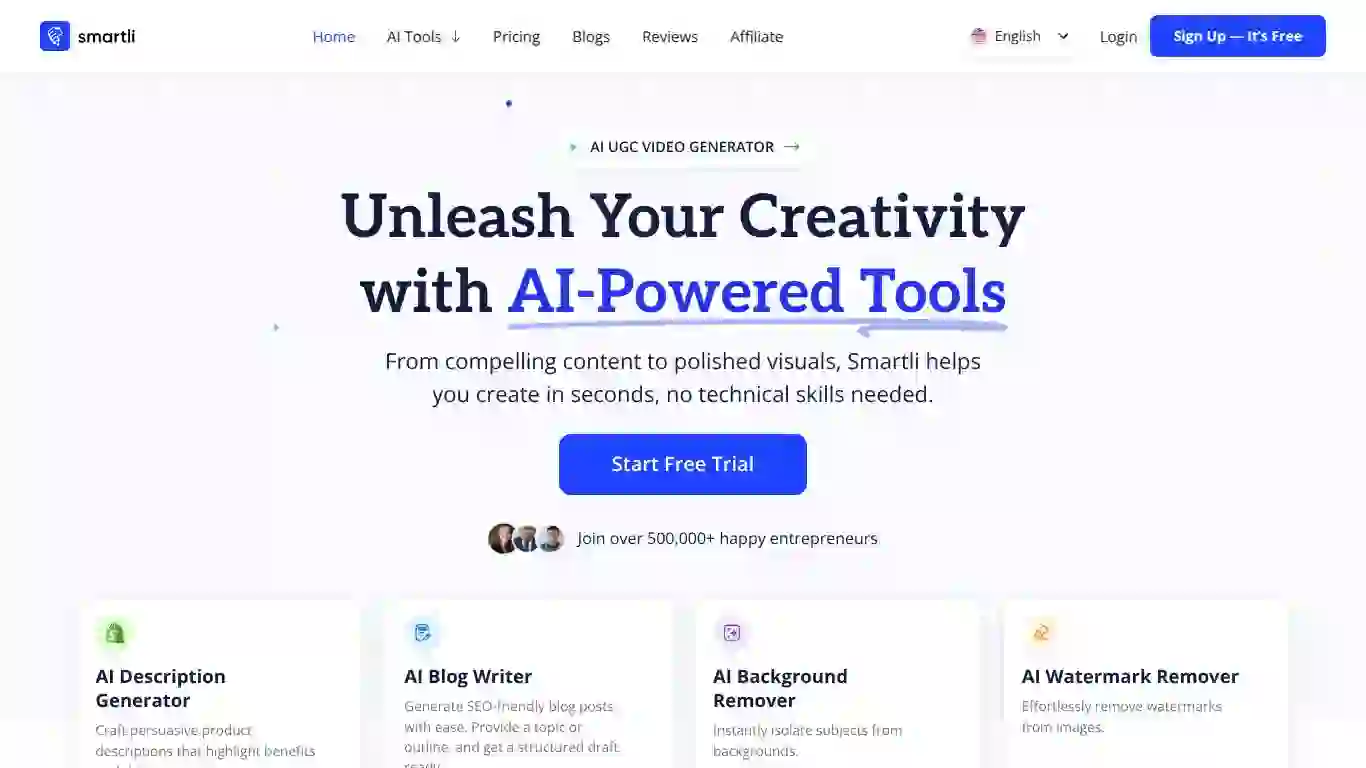
Smartli gives you an all-in-one suite for content creation without the complexity. You get a product description generator that turns basic product specs into SEO-friendly copy in seconds. The blog post writer creates structured articles with proper headings and keyword placement. You also get an AI ads writer for Facebook, Instagram, and Google campaigns. The platform supports batch processing, so you can generate hundreds of descriptions at once. Ecommerce sellers use Smartli to scale their product listings without hiring a writing team.
Key Features
- Bulk product description generation processes your entire catalog at once. You upload a spreadsheet and get optimized copy for every product. This saves days of manual writing.
- AI content humanizer removes robotic patterns from generated text. You select a tone like friendly or professional, and the tool rewrites everything to sound natural.
- Background remover and photo enhancer clean up your product images automatically. You get studio-quality photos without learning Photoshop.
- Watermark remover cleans images you need for marketing materials. One click removes logos and text overlays cleanly.
- Brand voice consistency across all content types. The tool remembers your tone preferences and applies them to blogs, ads, and descriptions alike.
- Multilingual support for reaching global markets. You generate content in Spanish, French, German, and more without retyping anything.
2. Gumloop
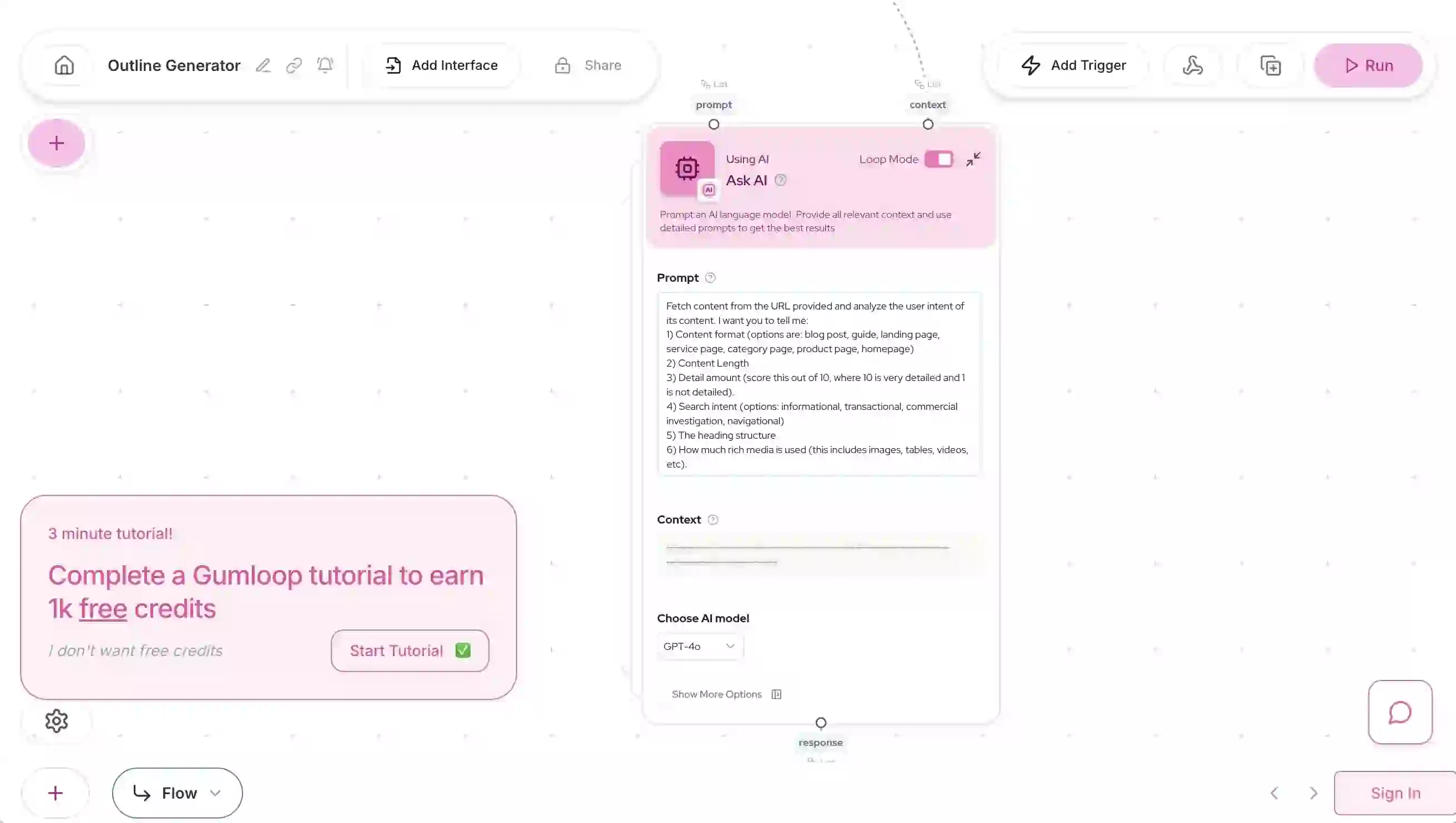
Gumloop is a no-code AI automation platform that connects your apps and automates repetitive tasks. You build workflows by dragging and dropping blocks. Each block can scrape websites, process data, or send emails. You don't write a single line of code. Marketing teams use Gumloop to automate lead qualification, content repurposing, and CRM updates. The platform integrates with Slack, Gmail, Salesforce, and 120+ other tools. You can trigger workflows when an email arrives or a file gets uploaded. It handles complex automation that would normally require a developer.
Key Features
- Visual drag-and-drop builder lets you design automation without coding. You connect pre-built nodes to create custom workflows in minutes, not weeks.
- AI-powered nodes generate text, summarize documents, and classify data inside your workflows. You add intelligence to every automation step.
- Pre-built templates for common marketing tasks like lead scoring and email handling. You start with a working template and customize as needed.
- Parallel execution runs multiple workflow nodes at the same time. You process large volumes of data without slowdowns.
- Real-time monitoring shows you exactly how your automations perform. You spot bottlenecks and optimize over time.
- Enterprise-grade security includes SOC 2 Type II and GDPR compliance. Your customer data stays protected.
3. HeyGen
HeyGen lets you create professional AI avatar videos without a camera or studio. You type a script, choose an avatar, and get a finished video in minutes. The platform supports 175+ languages with natural lip-sync. You can create product demos, training videos, and social content from a single prompt. The February 2026 updates added a ChatGPT integration for prompt-to-video workflows. You also get the Video Agent API for automating video production at scale. Marketers use HeyGen to personalize outreach without hiring video editors.
Key Features
- 230+ AI avatars with realistic expressions and gestures. You pick the look that matches your brand without hiring actors.
- Video Agent API turns prompts into finished videos automatically. You integrate video generation directly into your existing workflows.
- One-tap social editing on the iOS app polishes raw footage for TikTok and Instagram. You add captions and effects with a single tap.
- ChatGPT integration lets you generate videos without leaving the chat interface. You describe what you want and the agent handles everything.
- Audio dubbing with lip-sync translates your videos into other languages naturally. The avatar's mouth moves correctly with the new audio.
- Premium features include Avatar IV with improved realism and B-roll generation. Your videos look more professional with each update.
4. Nowfluence
Nowfluence is an AI operating system for influencer marketing. It handles creator discovery, verification, campaign management, and payment processing in one place. You stop searching through social media for relevant creators. The platform uses AI to match your brand with verified influencers who actually reach your target audience. You can forecast campaign results before spending a dollar. The AI-powered campaign builder cuts setup time from days to minutes. Nowfluence also tracks real sales attribution through Shopify integration. You see exactly which influencers drive revenue, not just likes.
Key Features
- AI-powered creator matching recommends ideal influencers based on your campaign goals. You get relevant partners without manual searching.
- Real-time sales attribution connects influencer posts to Shopify transactions. You measure actual ROI, not vanity metrics.
- Secure escrow payments through PayPal and Stripe protect both brands and creators. Money releases only when deliverables are verified.
- Automated deliverable tracking monitors content deadlines and quality standards. You don't chase creators for updates.
- Fraud detection algorithms verify audience authenticity. You avoid fake followers and engagement bots.
- Content studio produces short-form videos showcasing your products. You get professional creative at a fraction of agency costs.
5. NeuronWriter
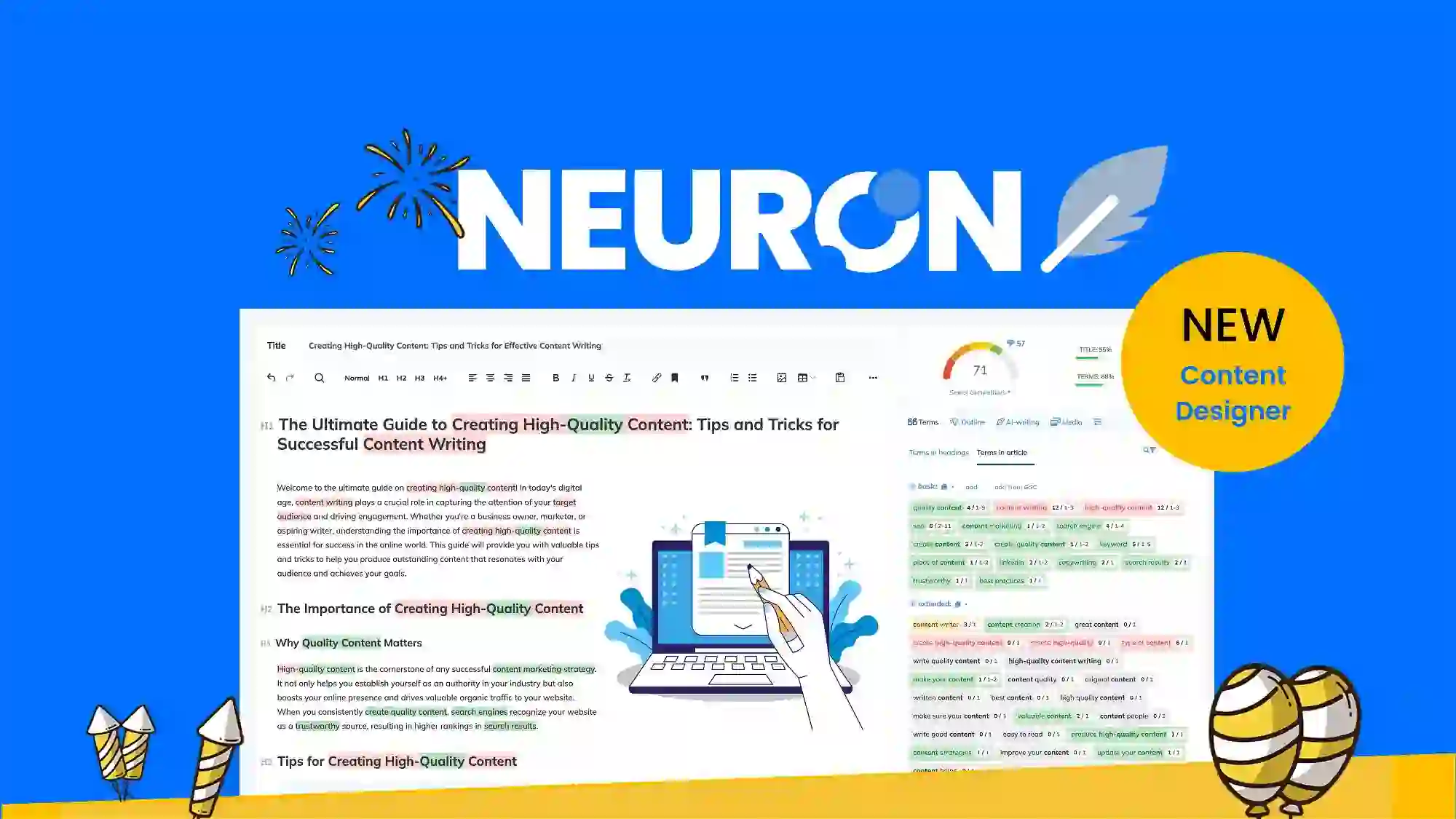
NeuronWriter is an SEO content optimization tool that competes with Surfer SEO at a lower price point. You enter a target keyword, and the tool analyzes the top-ranking pages. It shows you exactly which terms and phrases you need to include. The content editor scores your writing in real time and suggests improvements. You get NLP-driven term recommendations based on actual search data. NeuronWriter helps you build topical authority by mapping content clusters. SEO specialists use it to outrank competitors without guessing.
Key Features
- SERP analysis shows you what competitors are doing right. You see their word count, headings, and keyword density at a glance.
- Content score gives you a clear target to hit. You write until your article reaches the recommended threshold for ranking.
- NLP term suggestions come directly from Google's natural language processing. You use the same semantic terms that search engines expect.
- Internal linking recommendations build your site structure automatically. The tool suggests which pages should link to each other.
- Plans start at $23 monthly for the Bronze plan. The Gold plan at $69 includes unlimited projects and team members.
- API access on higher plans connects NeuronWriter to your existing publishing workflow.
6. Claude (Anthropic)
Claude is an AI assistant from Anthropic that excels at nuanced writing and long-form content. Unlike tools optimized for quick outputs, Claude understands context and maintains consistency across lengthy documents. Marketing teams use it for white papers, detailed blog posts, and campaign briefs. The model handles complex instructions without losing track of your brand voice. You can paste thousands of words of reference material, and Claude will write based on that specific context. The $20 monthly Pro plan gives you priority access and higher rate limits. Claude Sonnet 4.5 costs $3 per million input tokens for API users, which is cheaper than GPT-4o.
Key Features
- 200,000 token context window processes entire books or extensive brand guidelines. You never lose the thread of long conversations.
- Nuanced writing style produces content that needs minimal editing. You spend less time fixing awkward phrasing and generic statements.
- Consistent brand voice across multiple documents. Claude remembers your tone preferences throughout a conversation.
- API pricing advantage saves money at scale. Processing thousands of marketing briefs monthly costs less than competitors.
- Code interpreter helps with data analysis and technical marketing tasks. You can upload spreadsheets and ask for insights.
- File upload support for PDFs, Word docs, and images. You feed Claude your existing materials for accurate rewrites.
7. Perplexity Computer

Perplexity Computer is an AI agent that performs autonomous marketing tasks. You describe a goal, and the agent figures out the steps. It can scrape competitor websites, analyze ad performance, and optimize campaigns without your constant input. The tool claims to replace $225,000 worth of marketing software stack. You get an AI assistant that actually uses your computer to complete tasks. Enterprise customers can deploy Computer within Slack for team-wide access. The agent runs multiple processes in parallel and only pauses when it needs confirmation.
Key Features
- Autonomous task decomposition breaks down complex marketing goals into executable steps. You give high-level instructions, and the agent handles the details.
- Parallel processing runs multiple sub-tasks simultaneously. You get results faster than linear execution.
- Slack integration lets teams trigger and monitor agents from their chat app. No need to learn a new interface.
- Enterprise deployment options embed Computer where your organization already works. The tool fits your existing workflow.
- Web scraping capabilities pull competitor data and market intelligence automatically. You get insights without manual research.
- Campaign optimization runs continuously without human babysitting. The agent adjusts bids, targeting, and creative based on performance.
8. Mutinex
.webp)
Mutinex provides AI-powered marketing mix modeling (MMM) for data-driven teams. You feed it your marketing spend data across channels, and it calculates the true ROI of each dollar. The platform uses causal inference to isolate the impact of your campaigns from external factors. You stop relying on last-click attribution models that give all credit to the final touchpoint. Mutinex works for B2B and B2C companies with complex customer journeys. Marketing leaders use it to defend budget decisions with actual data. You get clear answers about which channels to fund and which to cut.
Key Features
- Causal inference models measure true campaign impact. You see what actually drove sales versus what just happened at the same time.
- Budget optimization recommendations tell you exactly where to shift spend. You reallocate dollars based on marginal ROI, not guesses.
- Scenario planning tools predict outcomes of different budget allocations. You test "what if" scenarios before committing real money.
- Channel attribution across complex journeys tracks influence across multiple touchpoints. You give proper credit to awareness and consideration channels.
- Integration with existing data sources pulls from your CRM, ad platforms, and analytics tools. You don't manually export spreadsheets.
- Executive dashboards present findings in plain English. You share results with stakeholders who don't speak data science.
9. Blackshark AI
Blackshark AI builds a photorealistic 3D digital twin of the entire planet using satellite data. You use this geospatial intelligence for location-based marketing and logistics planning. The platform extracts insights about infrastructure, population density, and land use from current imagery. Marketing teams use it to identify expansion opportunities and target regions with precision. You see where your customers live and how they move through physical spaces. Blackshark turns months of manual mapping into minutes of automated analysis. The platform serves enterprise customers and government organizations primarily.
Key Features
- Satellite imagery processing analyzes global visual data automatically. You get insights about any location on Earth without on-the-ground research.
- 3D digital twin generation creates accurate models of cities and regions. You visualize market opportunities in immersive detail.
- Infrastructure extraction identifies buildings, roads, and facilities from imagery. You understand the physical layout of target markets.
- Population density analysis shows where potential customers concentrate. You plan store locations and ad targeting with precision.
- Real-time updates reflect current conditions, not outdated maps. Your decisions use the latest available data.
- API access for integrating geospatial intelligence into your existing marketing platforms.
10. Octane11
.webp)
Octane11 is a B2B marketing analytics platform that connects your paid, owned, and earned marketing data to sales results. You stop managing disconnected spreadsheets from different channels. The platform maps every marketing signal—website visits, email opens, form fills—to actual accounts and pipeline revenue. You see which activities drive deals, not just engagement. The AI Assistant lives on every page and provides intelligent links to relevant dashboards. B2B marketing teams use Octane11 to prove ROI and optimize spend across channels. The platform focuses exclusively on B2B, so you don't deal with B2C features you will never use.
Key Features
- Unified data layer connects marketing, sales, and finance data. You see the complete customer journey from first click to closed revenue.
- Account-based attribution credits marketing activities to specific companies. You know exactly which campaigns reach your target accounts.
- AI Assistant provides intelligent links to dashboards from any page. You drill down into responses to see underlying data.
- Pipeline mapping tracks every marketing signal to real opportunities. You measure influence, not just direct attribution.
- B2B-focused feature set excludes consumer marketing noise. You get tools designed for long sales cycles and multiple stakeholders.
- Composable architecture lets you use only the components you need. You avoid paying for features that don't fit your stack.
Conclusion
AI marketing tools have moved from experimental to essential. You cannot compete manually against teams using automation. The tools above cover every major marketing function. You have content generation, SEO optimization, video creation, influencer management, analytics, and automation.
Pick one problem to solve first. Test a tool for 30 days. Measure the time saved and results gained. Then add another tool. Build your stack gradually. The goal is not collecting software. The goal is freeing your team to focus on strategy and creativity.
Start with Smartli for content needs. Try others for automation. Layer in analytics as you scale. You will see the difference in weeks, not months.
Top AI Marketing Tools 2026 FAQs
What are the best AI marketing tools for small businesses in 2026?
Small businesses get the most value from Smartli for content creation and Gumloop for workflow automation. Both offer free trials and affordable paid plans starting under $40 monthly. You can automate writing, scheduling, and data entry without hiring technical staff. These tools scale with your business as you grow.
How do AI marketing tools differ from traditional marketing software?
Traditional software stores data and helps you manage tasks manually. AI marketing tools act on data automatically. They write content, optimize ad bids, and personalize emails without your constant input. You set the goals, and the tool figures out the path. This shift from "tool you use" to "agent that works for you" is the key difference.
Can AI marketing tools completely replace human marketers?
No. AI handles execution and data analysis, but humans provide strategy, creativity, and emotional intelligence. You still need to understand your customers deeply. AI gives you more time for that high-level work. The best results come from humans directing AI, not replacing people with software.
Are free AI marketing tools worth using for serious campaigns?
Free versions work for testing and very small volumes. You face limits on credits, features, and support. Paid plans unlock the automation and scale that drive real ROI. Start with free trials to validate the tool works for your use case. Then upgrade to paid for serious campaigns. The $20-50 monthly investment pays back quickly in time saved.


%201.svg)


.avif)

.avif)